Whitehall Palace
Wolf HallWhitehall Palace, formerly York Place, is a royal residence and a working center of government in the novel. Its rooms and galleries hold both the staged intimacy of court life and the negotiations that transform royal marriage, parliamentary law, and the English Church. The palace is not merely a backdrop: it is where private decisions become public acts and where political authority is made visible.
Royal Rooms and Courtly Display
The palace is still being rebuilt when Henry VIII gives Anne Boleyn a bedroom there for Christmas. Its wall hangings are cloth of silver and cloth of gold, and the carved bed is covered in crimson satin embroidered with flowers and children. Henry leads Anne to see the room, making the gift a courtly spectacle as well as a private gesture. Henry Norris reports that Anne first surveys it slowly and smiles, then feigns a faintness at the honor; Henry leaves the New Year feast to escort her back into public view. The incident captures the palace’s double register: even a bedroom and its furnishings carry political meaning, and the court watches the king’s expression for signs of change.
Anne’s growing standing is visible in the palace’s social geography. When Thomas Cromwell visits her in the former cardinal’s rooms, she sits with her ladies and has already considered the political errors made by her father and brother. Her own judgment and tactical intelligence distinguish her from those attempting to direct her. In another encounter, she appears in a dark red gown in a Whitehall gallery, looking down into an inner court where Henry waits and the Duke of Norfolk moves about. From that vantage, Anne and Cromwell discuss the transfer of the Great Seal and the choice of a successor to Thomas More as Lord Chancellor. The gallery makes observation part of political action: they watch the king and interpret what he may do next.
Law, Counsel, and Royal Authority
Whitehall is also a place where policy is discussed and organized. In the early spring of 1532, Parliament considers measures to break episcopal resistance to Henry’s new order, including legislation to restrict payments to Rome and make royal supremacy over the Church more than a formal claim. Cromwell works through papers with Rafe Sadler and Call-Me-Risley, while Stephen Gardiner leads opposition among the prelates. The palace’s political world thus extends beyond the king’s immediate presence: drafts circulate through many hands before becoming measures that can alter jurisdiction and revenue.
The conflict is made personal when Catherine of Aragon speaks to Cromwell about the new laws at Windsor. She connects the prosecution of the clergy under the praemunire laws with the demand for a large payment, which she calls extortion, and condemns the effort to make the king head of the Church in England. Her challenge gives a human and political counterpoint to the legislative work associated with the court. The shift toward royal control is contested, not simply announced.
In 1534, Cromwell presents Henry with arguments drawn from Marsiglio of Padua, which deny that Christ made the Pope a ruler over secular princes and place churchmen under secular government. The exchange helps explain the ideas behind the regime’s claims of authority. Later, the king summons Cromwell and Gardiner to review a bill concerning the succession of Anne’s children. Anne reads over Henry’s shoulder, and the draft’s repeated description of her as his beloved wife sits beside provisions for the possibility of her death. Her reaction exposes the personal stakes concealed inside legal language: the measure secures a succession but also imagines her absence.
Ceremony and Political Change
Whitehall serves as the setting for acts that turn contested intentions into public or legal facts. On 15 May, the bishops submit to the king: they will make no new Church legislation without royal permission and will submit existing laws to review by a commission that includes laymen. The following day, from a gallery overlooking the garden, Cromwell and Anne watch Thomas More arrive without the Lord Chancellor’s chain. Henry waits below with the Great Seal. Anne and Cromwell discuss who might replace More; Cromwell suggests Thomas Audley, and Anne recognizes the importance of the choice. The scene links a visible change in office to a larger redistribution of power.
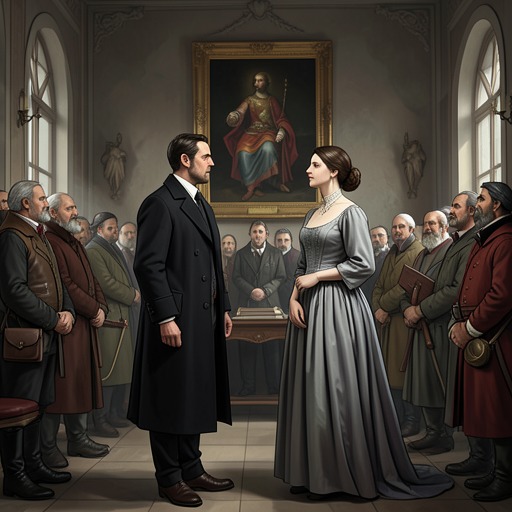
The palace is also the site of Henry and Anne’s secret marriage. At dawn on 25 January 1533, in a Whitehall chapel, they exchange vows before a small group of witnesses. Their ceremony confirms the contract they had made at Calais, but occurs without public celebration. The act is at once intimate and politically consequential: the marriage supports Anne’s position and the coming succession legislation, while its secrecy shows how far the court’s public presentation still lags behind its private decisions.
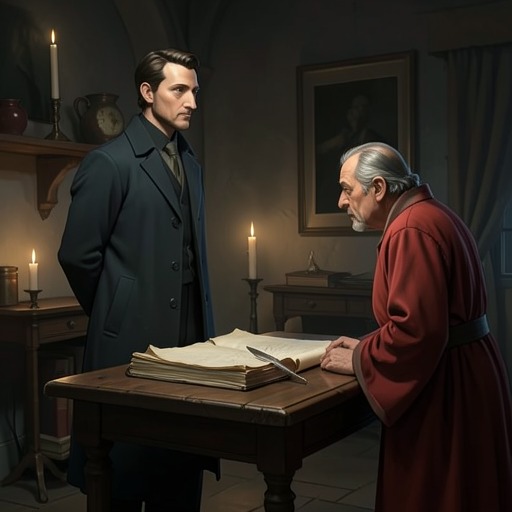
After the ceremony, Cromwell returns to drafting in his Westminster office. The king has given him a ruby ring as a sign by which Henry will recognize his papers, even without a seal. Cromwell removes that ring and Wolsey’s turquoise ring before writing the claim that England is an empire, governed by one supreme head and king. The movement from chapel vows to political text ties Whitehall’s courtly and governmental functions together: the palace is where royal marriage, succession, and sovereignty are made to reinforce one another.
Narrative Significance
Whitehall’s rooms repeatedly bring private relationships into contact with institutional power. Anne’s bedroom, the gallery above the inner court, the council’s deliberations, and the chapel each frame a different form of political performance: royal favor, watchful counsel, legislation, and marriage. Across these settings, authority depends not only on what the king intends but on the words, witnesses, documents, and offices through which that intention is given force.
The palace’s changing identity as York Place and then Whitehall also accompanies the transfer of power from Wolsey’s world into Henry’s court. Cromwell moves through the former cardinal’s rooms while advancing measures that alter Church government and royal succession. Whitehall therefore gathers the novel’s central political transformation into a single setting: private access to the king becomes an instrument of government, and the household’s ceremonies become part of the making of a new order.